
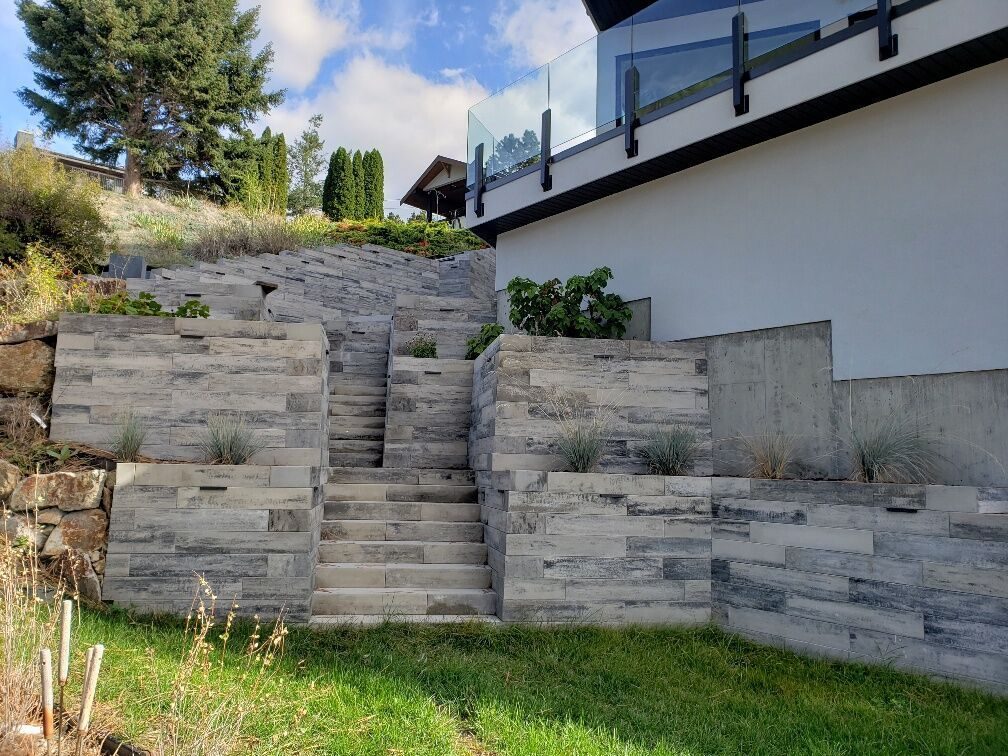
Retaining Walls in Winnipeg
Block and stone retaining walls built with the drainage and backfill that keep them standing on Winnipeg clay.
A retaining wall is doing structural work every day of its life. It is holding back soil, and on a Winnipeg property that soil is Red River Valley clay, which holds water, gets heavier when it does, and moves when it freezes.
That is why the walls that fail here tend to fail the same way. They lean outward, the courses separate, and the top of the wall stops running straight.
Drainage Is the Difference
Behind a properly built wall there is free-draining material and a path for water to escape. Without that, water collects in the backfill, the soil load goes up substantially, and the pressure on the wall goes up with it. Then winter arrives, that saturated material freezes and expands, and the wall gets pushed.
A wall built straight against clay with nothing behind it looks identical on day one. The difference shows up in year three.
We build with a compacted base set below grade, free-draining backfill, and drainage that actually takes water somewhere useful rather than just moving it a foot sideways.
What We Build
- Block retaining walls for grade changes and terracing
- Tiered wall systems where a single wall would be too tall
- Natural stone and boulder walls
- Stone steps and elevation transitions integrated into the wall run
- Planter and garden walls where the job is definition rather than load
- Walls tied into patios, walkways and fire pit areas as one design
Where Walls Earn Their Keep
Most Winnipeg lots are close to flat, so a retaining wall here is usually solving something specific. A walkout basement needing a proper transition. A yard that drops toward a neighbour. A patio that needs a level platform on ground that is not level. A grade against the house that should be running the other way.
Occasionally the honest answer is that the site does not need a wall, and regrading solves it for less money. We would rather tell you that at the estimate.
Materials
We use wall systems from Techo-Bloc, Belgard and Barkman, all engineered for cold-climate use, and natural stone where the property suits it. Because walls frequently sit next to patios and steps, it is worth choosing the materials for both at the same time so the finished result reads as one piece of work.
What's Included
- Drainage and free-draining backfill behind every wall
- Compacted base below grade, not laid on topsoil
- Tiered walls and stone steps for larger grade changes
- Techo-Bloc, Belgard and Barkman wall systems
Other Services We Offer in Winnipeg
Retaining Walls Questions
Why do retaining walls fail?
Water, almost always. A retaining wall holds back soil, and soil that cannot drain becomes heavier and pushes harder. On Winnipeg clay, which holds water rather than shedding it, a wall with no drainage behind it is carrying a load it was never designed for. Add frost to saturated backfill and the wall gets pushed outward.
Does my wall need an engineer?
Above certain heights, and in some situations below them, yes. Height, the slope above the wall, what sits behind it and whether anything is built near the top all factor in. We will tell you honestly when a wall is in engineered territory rather than building something that is quietly under-specified.
Can a retaining wall solve a drainage problem?
Sometimes, and sometimes it makes one worse. A wall changes where water goes, which is useful when that is planned and damaging when it is not. We look at the whole grade before proposing a wall, because occasionally the right answer is regrading rather than a wall at all.
What is the difference between a garden wall and a retaining wall?
Load. A low garden or planter wall is holding back very little and is largely decorative. A retaining wall is a structural element resisting real soil pressure, and it needs base preparation, drainage and backfill accordingly. The two can look similar and are not the same build.
Get a Free Retaining Walls Quote
Tell us what you are thinking and we will come and look at the property. You get a written estimate and a defined scope before anything is committed.