
Landscaping & Outdoor Construction in St. Vital, Winnipeg
Yard work on St. Vital's unusually deep river lots and the post-war streets behind them, from the Red River bank inland.
St. Vital sits on the east bank of the Red River in southeast Winnipeg, and it is among the oldest continuously settled parts of the province. It was named in 1860 by Archbishop Taché, in honour of Father Vital-Justin Grandin.
Riel House, at 330 River Road, was built between 1880 and 1881 and is a National Historic Site. Louis Riel lived there briefly in the summer of 1883, and after his execution his body lay in state in the family parlour.
St. Vital was an independent city from 1962 until it amalgamated into Winnipeg in 1972 as part of the Unicity project.
The River Lots Still Shape the Work
The parishes of St. Vital and St. Norbert were formally surveyed in April 1874 by Deputy Surveyor George McPhillips, into the river-lot pattern: long narrow strips running perpendicular to the river so that every household had frontage on it.
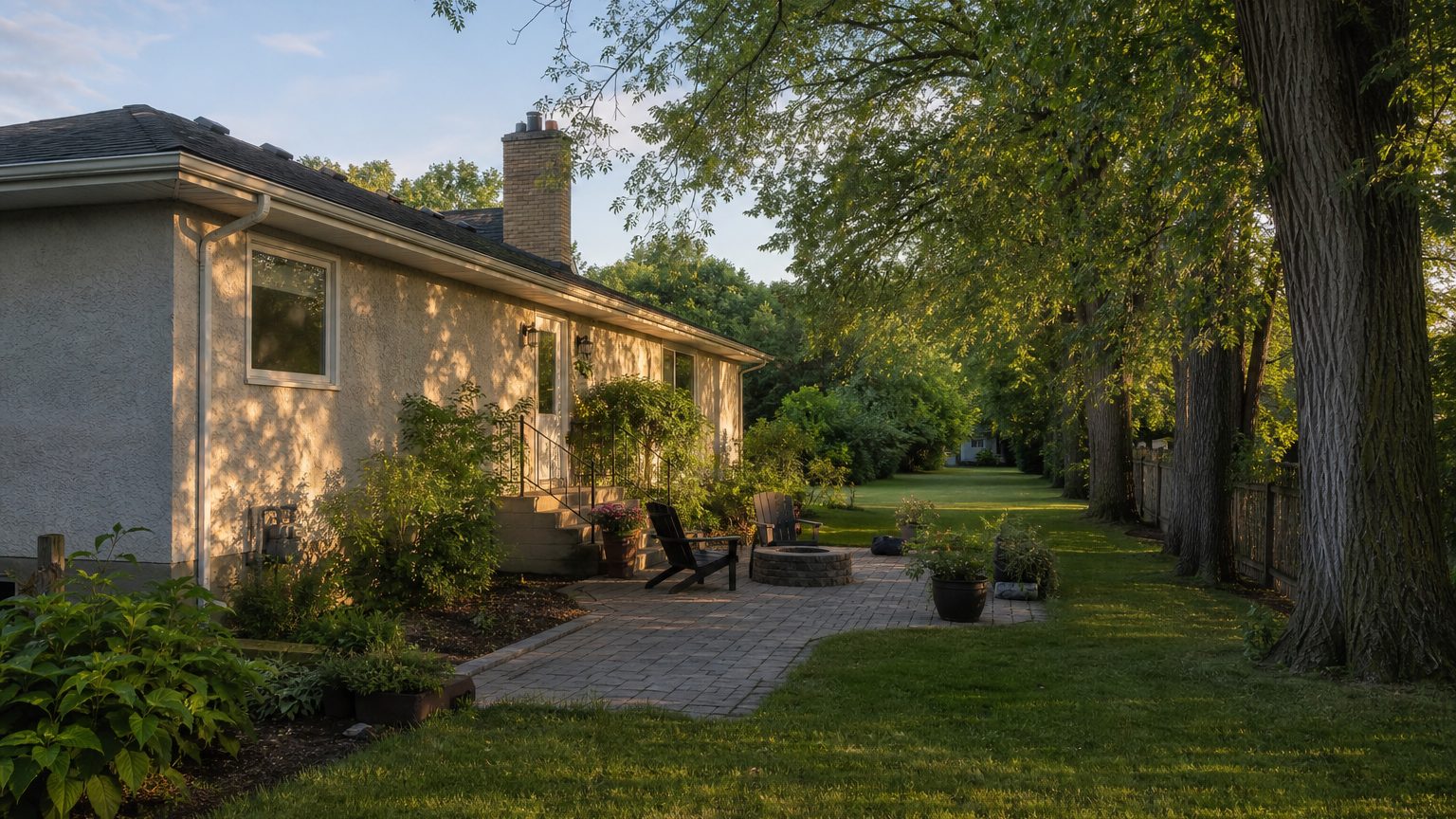
That survey is still legible on the ground. St. Vital’s diagonal streets follow those original property boundaries rather than a north-south grid, and a great many lots here are far deeper than anything in a modern subdivision.
For outdoor construction that depth is a genuine asset. There is room for a project with distinct areas, a patio near the house and something else further back, rather than one crowded space. It also means longer fence runs and more grading, so the quantities are larger even when the design is simple.
The River, and the Flood History
St. Vital’s relationship with the Red River is not only scenic. In the 1950 flood, almost the entirety of the district’s 20,000 residents were evacuated and the whole developed area was under water at one point.
Flood protection has changed enormously since, but the underlying conditions have not. Properties closer to the river have a higher water table, ground that stays soft later into spring, and in places a bank slope that needs to be respected rather than built over.
On a riverbank lot, where a deck or retaining wall can safely sit and where the best view is are not always the same place. That is a site-visit conversation, not a quote-over-the-phone one.
Post-War Streets, Yards at the End
Away from the river, much of St. Vital is post-war and mid-century housing with a later layer of subdivision through Southdale and Island Lakes.
The post-war stock is where most of our replacement work happens. Original grading has settled over sixty or seventy years, frequently reversing the fall away from the foundation, and decks and fences of that era are well past their service life.
The compensation is mature trees and ground that has long since finished moving.
What We Do in St. Vital
Decks, fences, paver patios and walkways, retaining walls, grading and drainage correction, sod and planting, excavation and site preparation, selective demolition, and snow removal through the winter.
Neighbourhoods We Serve in St. Vital
- Norwood
- Glenwood
- Southdale
- Island Lakes
Our Services in St. Vital
- Snow Removal in St. Vital
- Landscaping in St. Vital
- Deck Building in St. Vital
- Fence Installation in St. Vital
- Hardscaping & Paver Patios in St. Vital
- Retaining Walls in St. Vital
- Grading & Drainage in St. Vital
- Excavation & Site Preparation in St. Vital
- Sod Installation in St. Vital
- Artificial Turf in St. Vital
- Pergolas & Gazebos in St. Vital
- Demolition & Site Clearing in St. Vital
- 3D Landscape Design in St. Vital
St. Vital Outdoor Construction Questions
Why is our lot so long and narrow?
Because of the river-lot survey. The parishes here were surveyed in 1874 into long narrow strips running perpendicular to the Red River, so every household had river frontage. The pattern survives in the property lines and in the diagonal streets, and it is why so many St. Vital lots are far deeper than a modern subdivision lot.
Our property backs onto the Red. What should we know?
Bank slope and water table. Riverbank lots here carry slope stability considerations and ground that stays wetter longer, and St. Vital has real flood history. The flattest spot with the best view is not always ground that should carry a structure, which is a conversation worth having on site.
Does a deep lot cost more to finish?
More material, usually, but the depth is an asset. There is room for a project with several distinct areas rather than one crowded patio, and access down the side is often workable. The cost tracks what you build rather than the lot size.
Our house is from the fifties. Is the yard worth redoing?
Usually, yes. Post-war St. Vital housing has yards where the original grading settled decades ago and the deck and fence are well past service life. The advantage is mature trees and ground that has long since stopped moving.
Serving St. Vital and Nearby
Decks, fences, patios, landscaping and snow removal across St. Vital. Book a site visit and get a written estimate.