
Landscaping & Outdoor Construction in Transcona, Winnipeg
Yard work across Transcona's full range, from narrow 1920s railway-town lots to the post-war and modern subdivisions around them.
Transcona exists because of the railway, and the name records it. It is an amalgam of “Transcontinental” and “Strathcona”, after Lord Strathcona, the Manitoban who drove the final spike on Canada’s transcontinental railway.
The town was incorporated on 6 April 1912 specifically to house repair shops for the Grand Trunk Pacific and National Transcontinental railways, on 800 acres of flat, then-unoccupied land about 13 kilometres from downtown. The CN Transcona Shops opened in 1913 at a cost of $6 million and employed 5,000 men.
It built locomotives, too. CN 2747, completed on 19 April 1926 in 27 days at a cost of $37,765, was the first steam locomotive built in Western Canada. Roughly 33 more followed between 1926 and 1931.
Transcona amalgamated into Winnipeg on 1 January 1972 as part of the Unicity merger of twelve municipalities.
A Railway Town’s Lots Are a Specific Shape
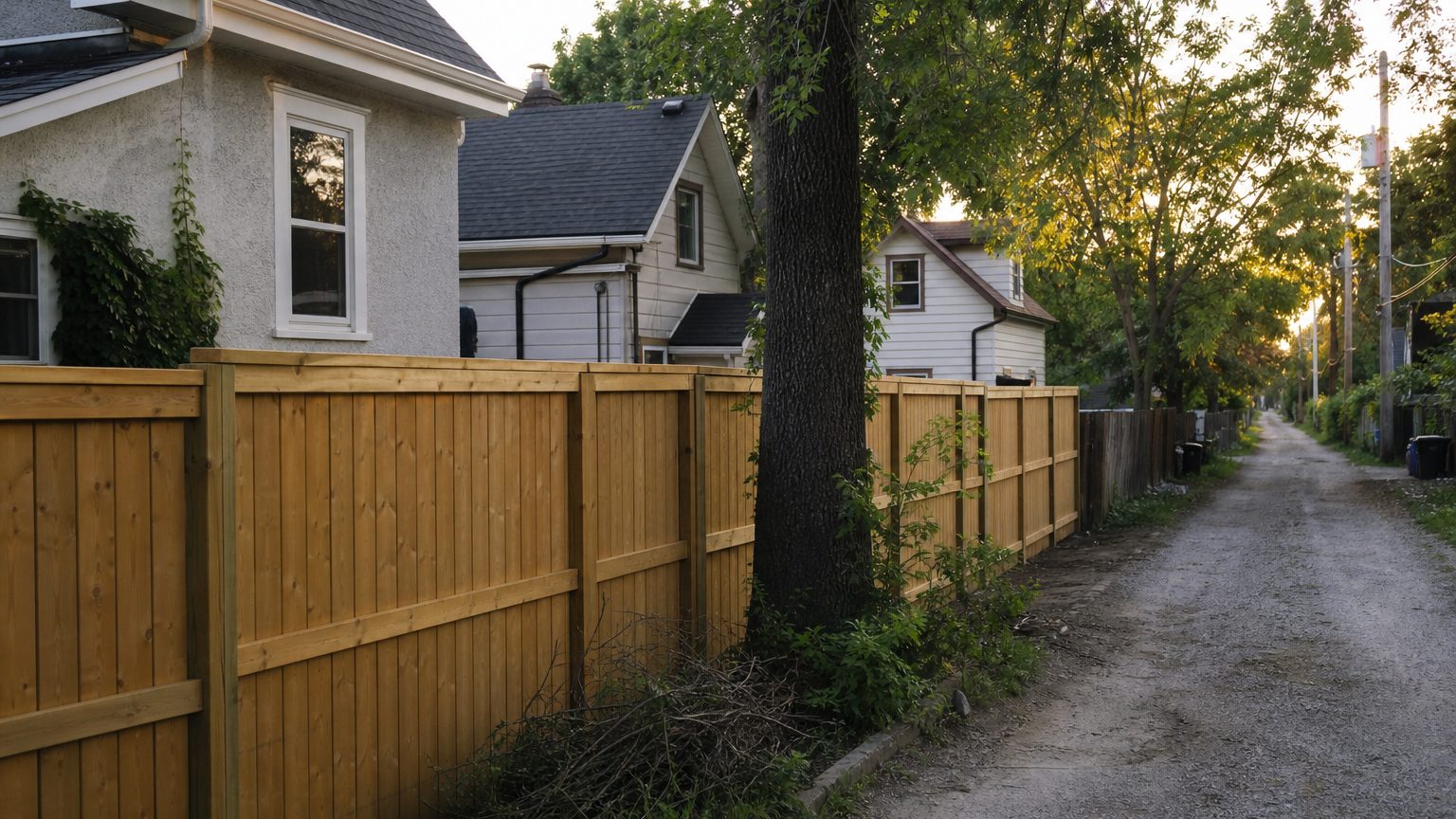
Housing built around a railway shop was built for workers, close together and close to the work. The result in the older core around Regent Avenue is a grid of narrow lots, many with rear lane access.
That shape has a direct effect on outdoor construction, and on balance a favourable one.
Narrow means side access is tight, sometimes too tight for a machine. But the back lane frequently solves that, and a lane is usually a better route for excavation and material than threading through a side gate. On a Transcona back yard, we look at the lane first.
Three Eras of Yard in One Neighbourhood
Transcona’s housing spans a wide range and the work changes with it.
The 1920s railway-era core has the oldest stock, on those narrow lots, where original structures are long gone and whatever is there now is itself likely due for replacement.
The post-war and 1950s to 1970s expansion produced areas such as Canterbury Park and Mission Gardens, with larger lots and yards that are now firmly at replacement age.
Modern subdivisions on the eastern edge are still bare-lot work.
The common thread is the ground. All of it sits on heavy Red River Valley clay, so frost depth, drainage and base preparation behave the same across every era.
The Leaning Fence Problem
Transcona has a lot of fences that have developed a wave along their length, and the cause is almost always the same: posts that did not reach frost depth.
Frost gets under a shallow post, lifts it, and the ground does not put it back. Over enough winters the line goes out of true, the gates stop latching, and the panels start to rack.
Straightening the panels does not fix it, because the problem is under the ground. We set posts a minimum of four feet down for exactly this reason.
What We Do in Transcona
Fences and decks, paver patios and walkways, retaining walls, grading and drainage correction, sod and planting, excavation, selective demolition, and snow removal through the winter.
Neighbourhoods We Serve in Transcona
- Regent
- Kildare-Redonda
- Canterbury Park
- Mission Gardens
Our Services in Transcona
- Snow Removal in Transcona
- Landscaping in Transcona
- Deck Building in Transcona
- Fence Installation in Transcona
- Hardscaping & Paver Patios in Transcona
- Retaining Walls in Transcona
- Grading & Drainage in Transcona
- Excavation & Site Preparation in Transcona
- Sod Installation in Transcona
- Artificial Turf in Transcona
- Pergolas & Gazebos in Transcona
- Demolition & Site Clearing in Transcona
- 3D Landscape Design in Transcona
Transcona Outdoor Construction Questions
Our lot is long and narrow with a back lane. Does that help or hurt?
It usually helps. Transcona's older railway-era lots are narrow, which makes side access tight, but many have rear lane access instead. A lane is frequently a better route for a machine and material than a side gate, and it can meaningfully reduce what a back-yard project costs.
We are in one of the newer subdivisions. Is the ground different?
Not really. Transcona sits on the same heavy Red River Valley clay as most of the city, so frost depth and drainage behave the same whether the house is from 1925 or 2015. What changes is whether you are replacing something or building from nothing.
Our fence has been leaning for years. Can it be straightened?
Rarely, and not durably. A fence that has developed a wave has almost always had its posts lifted by frost, and the problem is below ground. Straightening the panels addresses the symptom and the lean returns. Replacement with posts to proper depth is the fix.
How far east do you go?
Across Transcona and out past it. The east side is a reasonable run for us, and the neighbourhood's density means snow routes work here, which is not true everywhere we build.
Serving Transcona and Nearby
Decks, fences, patios, landscaping and snow removal across Transcona. Book a site visit and get a written estimate.